

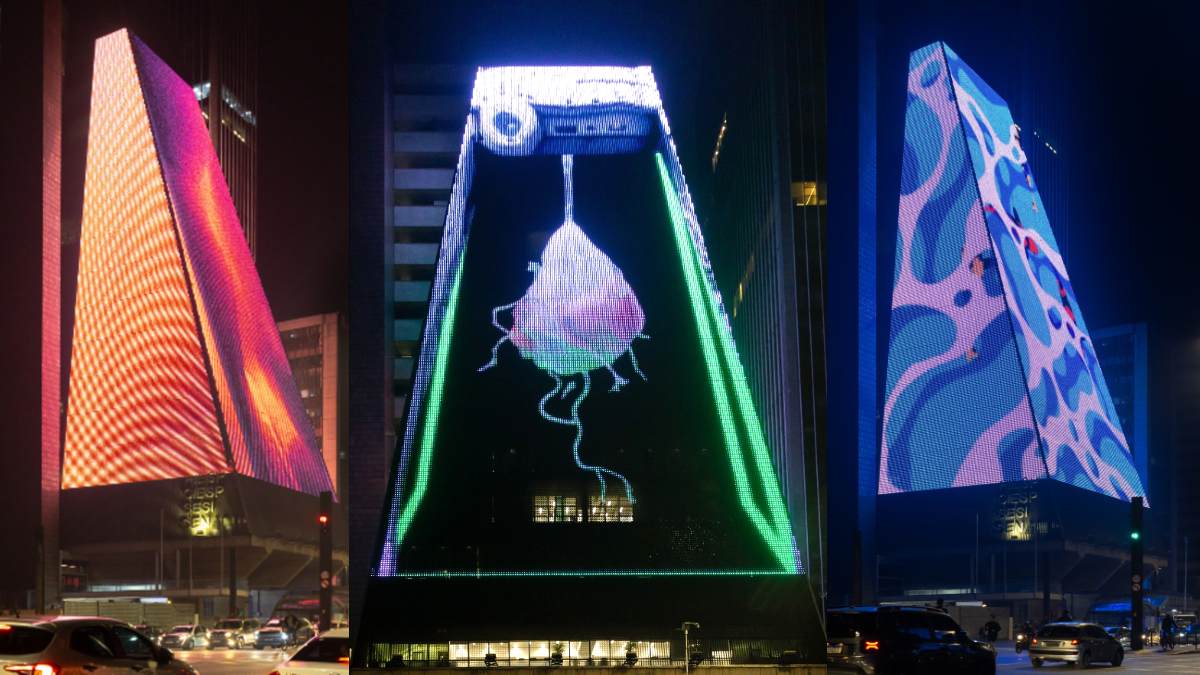
Rebuilding an icon: the engineering story behind the renovation of the FIESP Digital Gallery
On Projeções
When On Projeções (ON) first transformed the façade of the FIESP building on Avenida Paulista into a monumental digital canvas in 2012, there was no global reference.
Thirteen years later, the company was called upon to do something even more demanding: updating Latin America's largest permanent digital art gallery from the inside out, without altering the identity of one of São Paulo's most iconic architectural buildings.
It is important to underline that the façade of the FIESP is not an advertising medium: it functions exclusively as a digital art gallery, dedicated entirely to artistic and cultural content, without advertisements or commercial communication.
The result is well known: more than 120,000 LED dots, four times more resolution, eleven times more brightness and a completely modernized control architecture. What is less visible from the street is the technical and operational complexity that made this transformation possible.
This is the story behind the numbers of one of the most significant permanent LED art installations in the world.
From 26,000 to more than 100,000 points, and why it wasn't easy
The original system worked with 26,241 LED clusters, with an architecture that at the time was pioneering for its ability to reproduce video in real time on an unconventional façade.
Over the years, the technical and maintenance limitations of the technology available at the time became apparent. The constant exposure to the elements and the scale of the system demanded a profound evolution.
The new system represents a generational leap. The renovated façade now operates with a resolution of 480 × 322 points and a maximum brightness that is eleven times higher than the original system. Today's clusters integrate more efficient and stable LED technology, allowing for a significant improvement in performance, uniformity, and long-term reliability.
In addition, the connection architecture was completely redesigned to reduce operational risks and simplify maintenance, reinforcing the robustness of the system against the city's climatic conditions.
The technical leap is evident. The brightness went from 45 cd/m² to 471 cd/m², while the resolution evolved from 221 × 170 dots to 480 × 322, significantly multiplying the expressive capacity of the façade. The available color range was also expanded, the energy architecture was optimized and the control system was completely updated, consolidating a much more robust and future-proof platform. However, increasing resolution and brightness was only part of the challenge.
Weight, geometry and the restriction of the "invisible"
The FIESP building is famous for its trapezoidal shape and honeycomb-shaped façade structure. Any intervention must respect strict structural limits and preserve its architectural identity.
When the idea of significantly increasing cluster density emerged, it became clear that replicating the previous model was not feasible. The new system required a completely redesigned structural solution, lighter and at the same time stronger.
Each support was custom-developed, seeking a balance between structural safety, technical efficiency and absolute respect for the original architecture.
Equally important: the technology had to remain virtually invisible. From a distance, the façade had to preserve its formal integrity. The final solution represents a delicate balance: powerful yet unobtrusive, innovative yet integrated.
The façade covers 2,818 m² and was approached with a carefully distributed energy strategy to optimize efficiency, installed power and brightness levels. Approximately 157,000 clusters were installed, each designed to deliver high performance with greater energy efficiency than the previous generation.
The system was designed not to maximize consumption, but to maximize visual impact with intelligent brightness and content management. The façade operates around 14 hours a day, with dynamic control according to real conditions of use. The upgrade wasn't about consuming more power, but about delivering exponentially superior visual performance with greater control and efficiency.
Installation: Point-to-Point
The installation was completely manual and executed cluster by cluster, under demanding conditions. The team worked in tight spaces, facing varying weather conditions and continuously adapting the assembly strategy. The process involved on-the-fly adjustments, constant learning, and progressive optimization. Even experienced technicians described the project as one of the most demanding of their careers.
The irregular geometry of the building represented one of the biggest challenges. The new generation of the system required rethinking the integration logic to adapt to a non-orthogonal façade. After several initial tests and successive adjustments, the team developed a specific mapping strategy tailored to the building's unique geometry.
Commissioning involved multiple on-site validations, close coordination between teams, and continuous adjustments to achieve stable and consistent operation across the entire surface. More than a simple technological update, it was a process of adaptation and applied engineering.
The renewal was awarded after an international competitive process. One of the key requirements was a minimum long-term maintenance commitment.
The experience accumulated by ON over more than a decade operating the original façade was decisive. It was not just a matter of designing a new solution, but of understanding the actual behavior of a system of this scale over time. That know-how was key to modernization.
A legacy of continuous innovation
ON's cluster philosophy dates back to 2007, when the company developed experimental solutions for large-scale installations that could not be solved with standard technology.
Through a process of research, trial and error, and collaboration with international manufacturers, ON was refining its own technological approach, based on constant adaptation and iteration. The façade of FIESP was one of the first permanent applications of that philosophy. This renewal represents its natural evolution.
The façade operates under a semi-automated system. ON performs regular preventative maintenance and technical support when needed.
A mapping system adapted to the geometry of the building was developed to allow artists to create content with creative freedom, without facing the technical complexity of the infrastructure.
The improvement in brightness and resolution has significantly expanded the expressive possibilities. The digital gallery continues to operate exclusively as a space dedicated to art, reinforcing its cultural role in the city.
For ON, the project represents much more than a technical update. It is the reengineering of an urban icon under contemporary standards, keeping intact its architectural identity and cultural vocation. It demonstrates that permanent digital facades are not simply technological systems, but living cultural infrastructures that require engineering, architectural sensitivity, and long-term vision.
And perhaps most importantly: it shows that, sometimes, the most difficult thing is not to make a façade brighter, but to integrate it in a respectful, stable and lasting way into the city that welcomes it.