


Latin America. The sustainability conversation in organizations is no longer limited to reducing paper or energy consumption. Today, the real question is how digital transformation in the workplace can become a real enabler of more efficient, measurable, and accountable operations.
In Latin America, the combination of digital transformation, automation and new workplace solutions is redefining the way companies operate. Sustainability is no longer an isolated program: it is a direct consequence of how smart workplaces, smart offices, and hybrid work models are designed.
Operational sustainability does not depend only on environmental policies. It depends on integrated infrastructure, processes, and technology decisions.
What connects sustainability and technology in the workplace?
1. Process automation = less waste
Process automation reduces unnecessary resource consumption, optimizes workflows, and reduces errors that lead to rework.
Automated offices allow lighting, air conditioning and occupancy to be managed in real time, reducing energy consumption and improving operational efficiency.
Direct impact: lower environmental footprint and cost reduction.
2. Digital workplace
The evolution towards a digital workplace decreases dependence on physical documents, storage and transport. Digital adoption allows manual processes to be migrated to more controlled and auditable digital environments.
However, there are still barriers to digital adoption in the region: fragmented infrastructure, cultural resistance, or lack of integration between platforms.
Overcoming them implies having an IT technology integrator capable of connecting systems, processes and equipment under the same strategy.
3. Smart workplaces and energy efficiency
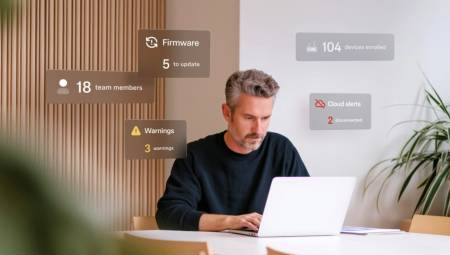
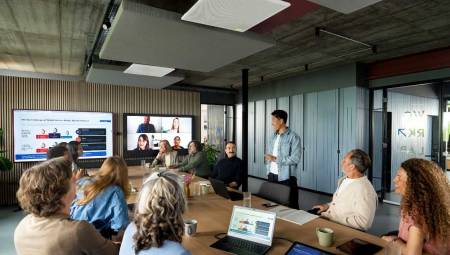
Smart workplaces integrate sensors, monitoring, and analytics to optimize space utilization. This is key in hybrid work schemes, where occupancy is constantly changing.
Smart workplaces enable:
- Adjust energy consumption according to actual occupancy
- Manage technology assets centrally
- Reduce unnecessary commuting
- Sustainability ceases to be reactive and becomes structural.
4. IT Services and Operational Sustainability
IT technology solutions and IT services for companies also impact sustainability. Managed models reduce hardware over-provisioning, optimize lifecycles, and enable reverse logistics to be implemented for responsible reuse and recycling.
In addition, having an IT technology provider with ISO certifications and structured regional operations, such as a Distribution/Operations Center, ensures energy efficiency, environmental management, and traceability standards.
Sustainability is not an additional layer. It is the result of workplace transformation. When technology, automation, and operational strategy are integrated, environmental impact decreases and efficiency increases.
"Sustainability in the workplace is not only about reducing consumption, but about redesigning how processes operate. Well-integrated technology allows you to do more with fewer resources," said Esteban Ureña, Ricoh LATAM Specialist.
The evolution towards greener operations does not happen by declaration, but by technological architecture.
Sustainability then becomes a natural indicator of digital maturity.
Technology can be an accelerator of efficiency and sustainability when it is properly integrated.
Text published by the company Ricoh Latin America.