

Mexico. The adoption of smart devices in homes is no longer an emerging trend but an everyday reality. More and more families are integrating voice assistants, connected security systems, automated lighting, and smart appliances, among many others, into their daily lives.
Between 2023 and 2025, there is sustained growth in home connectivity and in the adoption of smart devices with an internet connection.
Digital Infrastructure at Home
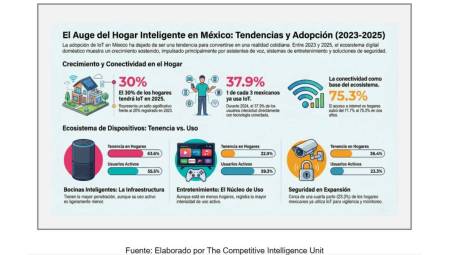
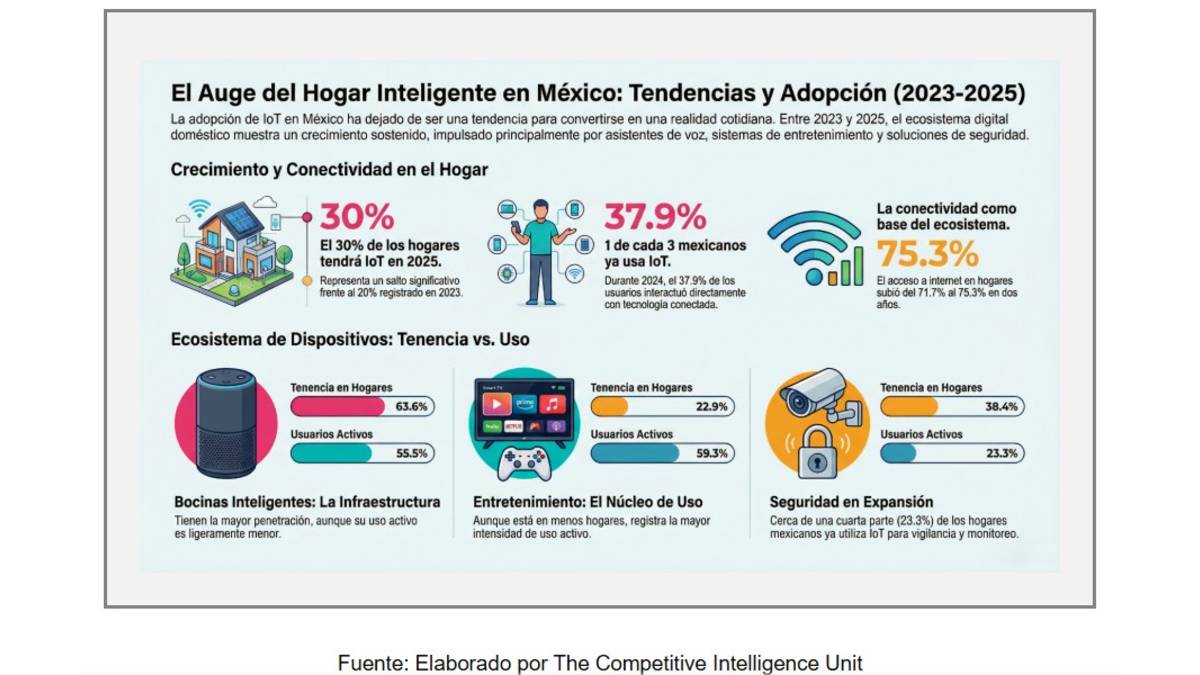
While the proportion of households with internet access went from 71.7% in 2023 to 75.3% in 2025, an even more significant increase took place in households with connected IoT ('Internet of Things') devices, going from 20% in 2023 to almost 30% in 2025, based on information from the National Survey on the Availability and Use of Information Technologies in Households (ENDUTIH) carried out by INEGI.
This advance reflects how digital infrastructure is consolidated as the basis for the expansion of the smart ecosystem in the home.
Simultaneously, the number of IoT device users also increased significantly, from 27.6% in 2023 to 37.9% in 2025.
This growth shows that not only do more homes have connected devices, but that more and more people are interacting with them, by integrating voice assistants, entertainment systems and security solutions into their daily lives.
IoT Device Ownership
ENDUTIH figures show that entertainment devices are the most used within the IoT ecosystem in the home, with 59.3% of active users, although their presence in homes is lower (22.9%).
In contrast, speakers with virtual assistants register a greater adoption in homes (63.6%), to reach a count of just over 7 million devices, but a slightly lower level of use (55.5%), which suggests that they function more as connectivity infrastructure than as devices of constant use.
Other segments such as surveillance (38.4% of households, 23.3% of users) and smart lighting (13.4% of households, 10.1% of users) reach a more gradual tenure, in the process of mass adoption.
At the low end, appliances, electrical connections, digital locks, and thermostats are in the vicinity of 5%, both in adoption and use, indicating that the IoT ecosystem still has ample room for expansion in practical home functions.
The IoT ecosystem in the home has seen steady growth in recent years, going from a nascent trend to becoming a key component of everyday life.
The expansion of devices such as voice assistants, entertainment systems, surveillance and smart appliances reflects how connectivity has ceased to be a luxury and has become a tool for efficiency, security and convenience.
This breakthrough shows that smart homes not only respond to current needs, but also open the door to new ways of interacting with technology.
Looking ahead, the outlook points to greater interoperability between devices, the use of Artificial Intelligence (AI) to anticipate needs, and the expansion of sustainable energy solutions that optimize resources, personalize experiences, and improve quality of life.
The promise of IoT in the home is to achieve an increasingly connected, adaptive, and people-centered environment, in which technology is an invisible ally that facilitates daily life.
Analysis by Fabrizio Vargas of The Competitive Intelligence Unit, The CIU.