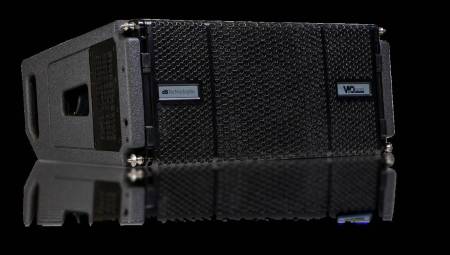


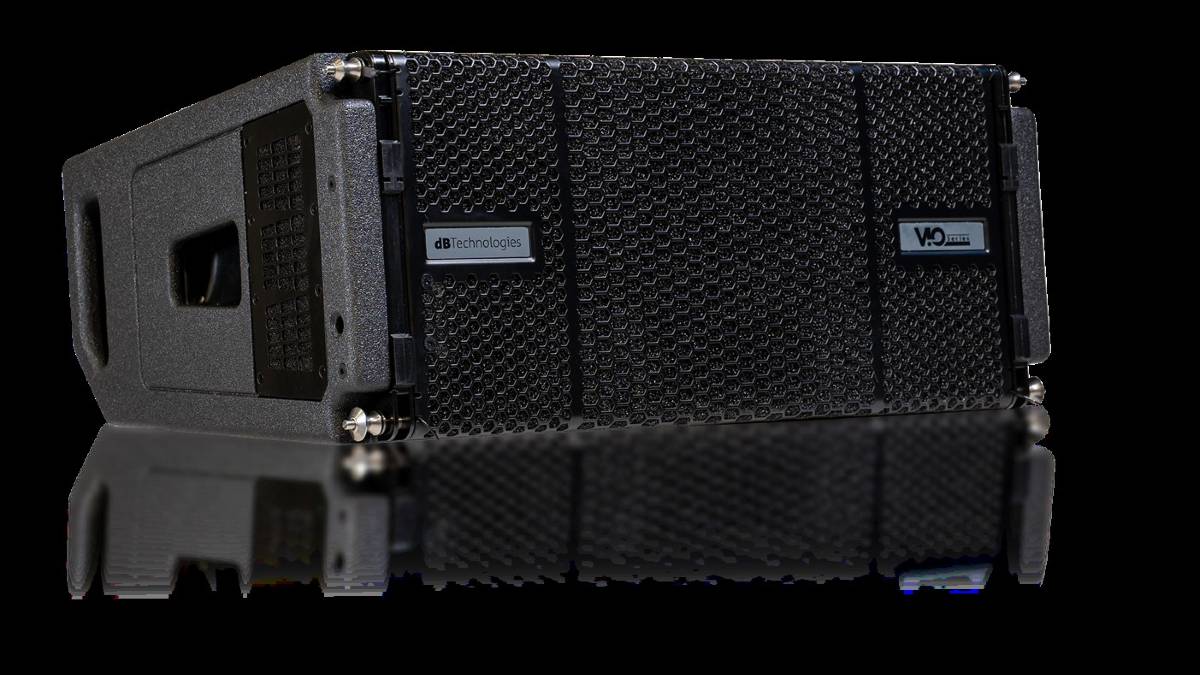
Latin America. When the dBTechnologies engineering team began developing the newest member of the VIO Series, the goal wasn't simply to build another compact line array. The ambition was much greater: to create a true 3-way system the size of a traditional 2-way and double 8" venue, capable of delivering impressive output, exceptional clarity and the flexibility required in today's touring and installation environments.
The VIO L1608 drives the company's R+D towards a precisely-scaled acoustic architecture; In other words, it delivers three-way performance in an enclosure the size of a traditional 2-way and double 8" array.
Although its size mirrors that of a standard compact 2-way array, the L1608 is unmistakably a 3-way design. Inside the enclosure, two 8-inch neodymium low-frequency (LF) transducers work in conjunction with a mid- and high-frequency coaxial array (MF-HF) powered by a 1600 W RMS Class D amplifier.
An optimized waveguide in the coaxial array and a low crossover point, around 600 Hz, extend some of the midrange into the speaker, producing a stable horizontal response and an open, natural midrange character that transmits evenly across all listening positions.
All of this is complemented by dBTechnologies' side-firing Bassreflex port geometry, which manages airflow through the side acoustic pathways to reduce turbulence, stabilize internal pressure, and increase efficiency at low frequencies. This design contributes to the outstanding performance of the system relative to its small volume, offering the possibility for a single technician to transport, deploy and transport it in flight, if necessary, without sacrificing performance.
For the first time in a VIO module, the award-winning A2Net protocol is included as standard, enabling high-resolution digital audio distribution and complete control of Aurora Net. The optional Dante™ interface is still available for network environments that require advanced routing and integration.
As part of the VIO ecosystem, the L1608 fully benefits from the unified platform established with firmware 2.0. All VIO modules running this firmware share the same phase response, latency, and input sensitivity, allowing engineers to deploy different models with complete consistency.
This uniformity allows the L1608 to function as a standalone main sound system, as a compact touring system, as a downfill or sidefill for larger arrays, such as the VIO L1610 or L212, or as a flexible utility in complex touring setups. For rental companies, this uniform behavior across all formats reinforces VIO's user-centric philosophy: every box on the VIO platform functions as part of the same sound and operational language.
The introduction of the DRK-28 flybar further contributes to this unified workflow. Compatible with both hung and stacked configurations, and with direct mounting on the dolly, the DRK-28 reduces the need for accessories, speeds up loading and simplifies logistics in compact VIO systems. Its compatibility ensures predictability of deployment practices.
With its distinctive acoustic architecture, compact size and power, the VIO L1608 represents an evolution in compact professional sound reinforcement. By delivering three-way performance in such a small box size, while maintaining flexibility, efficiency, and consistent system behavior, the L1608 offers a powerful solution for touring professionals, facility designers, and rental providers looking for increased system capacity.