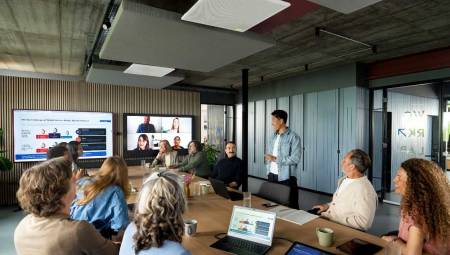


Latin America. The consolidation of hybrid work in Colombia has ceased to be an emergency response and has become a pillar of the digital economy.
According to recent data from the Colombian Chamber of Informatics and Telecommunications (CCIT), the adoption of remote and hybrid work models has driven a 15% growth in demand for corporate technological infrastructure in the last year, reflecting a critical need of professionals for tools that guarantee continuity and security outside the traditional office.
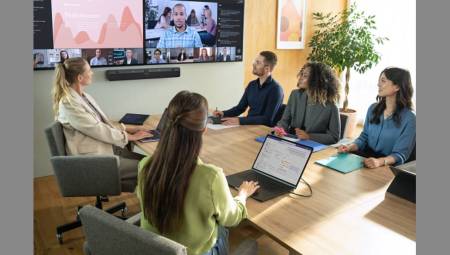
This evolution has transformed the nature of hardware. It's no longer enough to just have a computer; today's ecosystem calls for devices that act as mobile productivity hubs, integrating artificial intelligence for noise cancellation into video conferencing and enterprise-grade biometric security systems.
In this scenario, global players such as Microsoft, with its cloud collaboration ecosystems, and hardware manufacturers have had to redefine portability, prioritizing battery life and physical resistance in the face of constant travel.
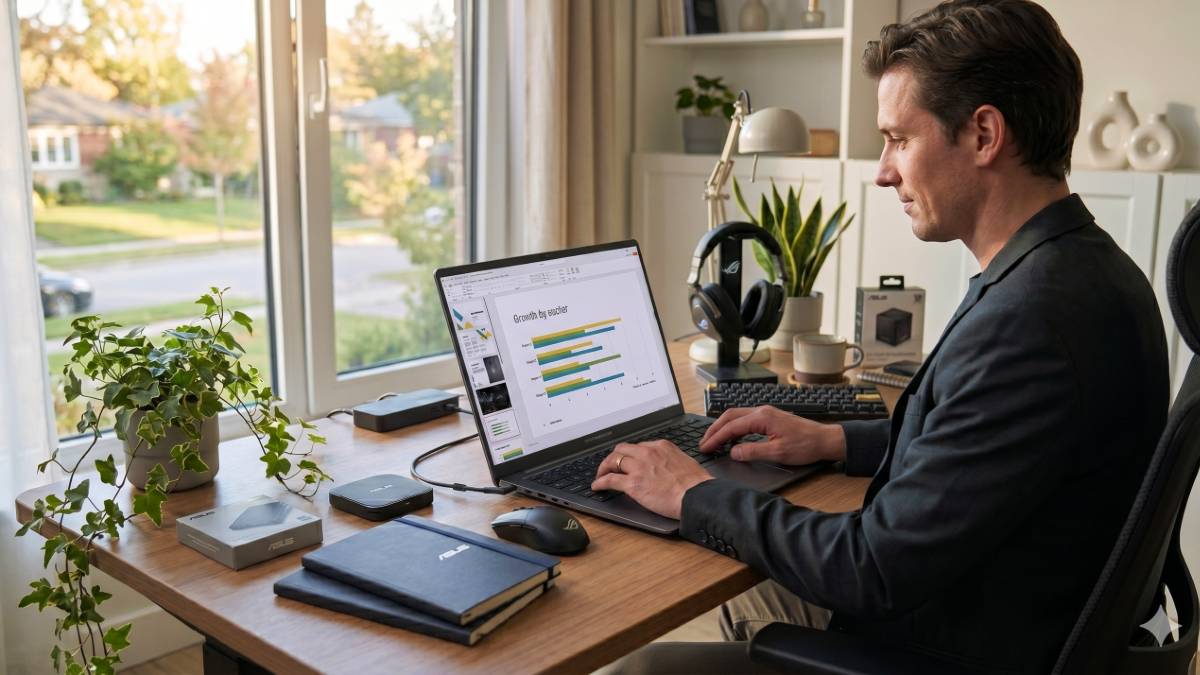
The industry has responded with innovations that seek to remove friction from the home environment. For example, the architecture of devices such as the ASUS ExpertBook series reflects this trend toward military durability and remote management, allowing IT departments to secure sensitive information even on vulnerable home networks.
For professionals who demand versatility, equipment like the Vivobook line has balanced youthful design with performance capable of withstanding long days of multitasking. Likewise, the rise of the creator economy in remote environments has driven high-end solutions such as the ProArt series, designed specifically for those who require superior color accuracy and processing power for video editing and 3D design from anywhere.
The vision of industry leaders points to an increasingly invisible integration between user and machine.
"Technology is transforming the way people create, work, and connect. We no longer design equipment thinking only about specifications, but about how hardware evolves to adapt to new forms of productivity that demand absolute flexibility and security without compromises," Felipe Llano, ASUS PR Manager for Colombia and Ecuador.
Going forward, the convergence between artificial intelligence and consumer hardware is expected to continue to remove the barriers of distance. The office of tomorrow will not be a physical place, but a technical capability contained in increasingly intelligent and resilient devices, capable of keeping pace with a workforce that values, above all else, autonomy and efficiency.